

TL;DR:
- Authentic chef-led travel extends beyond restaurant skills and incorporates regional knowledge, storytelling, and producer relationships that deeply enrich the experience. Such journeys involve chefs in designing itineraries, guiding market and street explorations, and fostering genuine community connections that foster emotional engagement and repeat visits. To truly benefit from chef expertise, travelers should seek tours where chefs have long-standing local partnerships, curated multisensory content, and active involvement throughout the entire journey, not just at the final meal.
Most travellers assume that “chef-led” simply means a famous face plating a tasting menu in a candlelit dining room. That assumption is costing them the most rewarding food experiences of their lives. Real chef expertise in travel goes far beyond restaurant skills. It shapes every element of a journey, from how you navigate a morning market in Seville to what you understand about a bowl of street food in Mexico City. This article explores how genuine chef expertise redefines culinary travel, what separates a truly immersive experience from premium theatre, and how you can make sharper choices when booking your next food adventure.
Table of Contents
- What chef expertise really means in travel
- How chef expertise shapes authentic culinary journeys
- From the spectacle to street: distinctions in chef-led experiences
- Making the most of chef expertise: how to choose and enjoy your journey
- Our perspective: the truth most travellers miss about chef-led journeys
- Ready to unlock chef-led culinary adventures?
- Frequently asked questions
Key Takeaways
| Point | Details |
|---|---|
| Chef expertise drives authenticity | Travelling with a chef unlocks genuine experiences with local cuisine and culture beyond standard tours. |
| Spot immersive chef-led tours | Look for journeys designed by chefs that include market visits, producer meetings, and hands-on culinary learning. |
| Balance spectacle and substance | The best chef-led tours combine technique and narrative with real community connections, not just fine dining. |
| Ask questions to maximise value | Research chef backgrounds and itinerary details to ensure an authentic, immersive food adventure tailored to your interests. |
What chef expertise really means in travel
To understand why chef expertise matters so deeply in travel, it helps to be specific about what chefs actually know that a standard guide does not.
A chef’s knowledge is technical, layered, and deeply regional. They understand why a particular olive variety produces a fruitier oil in one valley than in the next. They know which market stall sources heritage tomatoes directly from a specific farm, and why that matters to flavour. They can spot when a “traditional” dish has been adapted for tourist palates and explain precisely what has been lost. This kind of granular, sensory knowledge is simply not available through a standard guided tour.
Beyond ingredient knowledge, chef expertise brings a set of skills that chef expertise transforms tours in several distinct ways:
- Market navigation: Chefs know how to move through a food market with purpose, introducing you to the producers who rarely speak to tourists and explaining how seasonal availability shapes the region’s cooking calendar.
- Technique demonstration: Even a brief explanation of why a Berlin chef ferments cabbage differently from a Parisian charcutier adds a layer of understanding that stays with you long after you’ve returned home.
- Storytelling rooted in craft: The best chef guides connect history, culture, and flavour in a single conversation. They translate culinary heritage into something you can taste.
- Producer relationships: Years of professional sourcing mean chefs can open doors to smokehouses, bakeries, and cellars that simply are not accessible to the general public.
“Culinary activities such as cooking classes and chef encounters are linked to emotionally meaningful, multi-sensory tourist experiences.” This is not marketing language. Academic reviews confirm that gastronomy functions as an experiential consumption category, where the depth of engagement directly shapes emotional impact.
Crucially, research also confirms that food authenticity and memorable culinary tourism experiences are directly associated with revisit intention. Travellers who have genuine, chef-shaped encounters with a city’s food culture are measurably more likely to return. This is not coincidental. It reflects the fact that authentic experiences satisfy curiosity in a way that spectacle never can.
For a sense of how this works outside the city setting, the approach to authentic Provence food experiences illustrates beautifully how producer relationships, regional knowledge, and culinary storytelling combine to create something a typical itinerary could never replicate.
How chef expertise shapes authentic culinary journeys
Once you grasp what chef expertise means, it’s time to see how this expertise gets woven into high-impact, memorable travel experiences.
The most important thing to understand is that chef expertise is not deployed only in the kitchen. The most effective culinary travel programmes use a chef’s knowledge at every stage of itinerary design. Which neighbourhoods deserve a morning visit before the tourists arrive? Which producers are doing something genuinely interesting with traditional methods? How should tastings be sequenced so that bold flavours do not overwhelm more delicate ones? These are design decisions that only a working chef can make well.

This model is gaining recognition at the highest levels of the travel industry. Orient Express Venezia appointed Michelin-starred Chef Heinz Beck to oversee their entire gastronomic offering, aligning every dining experience aboard the train with a coherent culinary concept. This illustrates how culinary authorities are now being used to shape guest experience at a systemic level, not merely as ad-hoc personalities for a single dinner. The logic is clear: when a chef’s philosophy runs through every element of the experience, the result is coherent, credible, and deeply satisfying.
Here is a direct comparison that shows why this matters for the traveller:
| Element | Chef-led experience | Generic guided tour |
|---|---|---|
| Market visits | Chef introduces specific producers and explains sourcing | Standard walk-through with general commentary |
| Food tastings | Sequenced and contextualised by flavour and technique | Ad hoc, focused on convenience |
| Cultural context | Embedded in cooking history and regional identity | Broad historical overview |
| Access | Hidden kitchens, producer cellars, private tastings | Publicly available venues |
| Repeat value | High, driven by authentic engagement | Lower, experience easily replicated elsewhere |
The role of chefs in tourism is increasingly understood as one of curation and interpretation, not just performance. For travellers seeking deeper engagement, this distinction is everything.
Pro Tip: Before booking any food journey, ask specifically whether the chef designed the itinerary from scratch or was brought in simply to host a meal at the end. The former indicates genuine expertise at work throughout the experience.
Research on culinary travel for professionals consistently shows that the depth of chef involvement is the single strongest predictor of overall guest satisfaction and the likelihood of recommending the experience to others. The key to authentic food travel is not the restaurant’s star rating. It is the quality of the human knowledge guiding you through it. You can also find this principle at work in how luxury food travel insights frame the highest-quality experiences: not by price point, but by the depth of local connection.
From the spectacle to street: distinctions in chef-led experiences
Understanding chef expertise in travel leads us naturally to the next question: how can you tell if a chef-led experience is truly local and immersive, or simply a premium spectacle?
This distinction matters enormously. The market for “chef-led” travel has grown rapidly, and not every product on offer delivers what the label implies. Some experiences are built around a celebrity name rather than genuine local knowledge. Others offer a single Michelin-grade dinner bookended by standard sightseeing, with very little authentic culinary substance in between.
Itinerary evidence from curated programmes shows how thoughtful operators counter this tendency by integrating market visits, producer encounters, and hands-on technique well before any fine dining element appears. The sequencing itself is a signal: if the fine dining comes first and the “authentic” elements feel like extras, the priorities are probably wrong.
Academic research characterises genuine culinary tourism as multi-sensory, emotionally resonant, and tied to active participation. Watching a chef cook for you is pleasant. Learning why they choose a specific cut, a particular spice, or a regional fermentation method from a local producer changes how you understand food for the rest of your life.
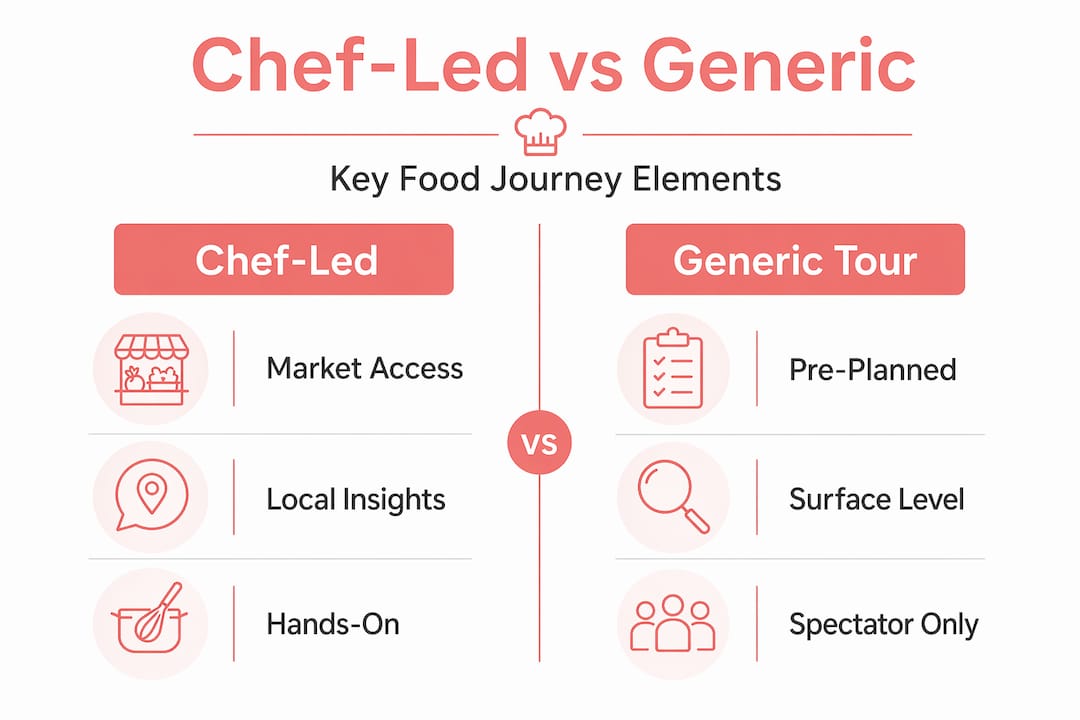
Here is a data-driven summary of key differences to watch for:
| Marker | Authentic chef-led journey | Spectacle-driven experience |
|---|---|---|
| Chef involvement | Throughout the itinerary | Single meal or demonstration |
| Local producers | Named, visited, and introduced | Referenced only in passing |
| Street food and markets | Core elements | Optional additions |
| Community connection | Genuine relationships visible | Staged or performative |
| Flexibility | Adapts to seasonal availability | Fixed regardless of season |
How to spot an authentic chef-led tour:
- The chef is named and their local background is clearly explained, not simply their restaurant credentials.
- The itinerary includes at least one market or producer visit where the chef has an established relationship.
- Street food and neighbourhood exploration appear alongside, not beneath, fine dining elements.
- The group size is small enough to allow genuine conversation with the chef throughout.
- Seasonal variation is acknowledged: authentic programmes change their content based on what is available locally.
- Reviews mention specific moments of learning or discovery, not just the quality of the food itself.
Understanding how chefs function as guides rather than performers is what separates a satisfying food trip from a truly transformative one. For further context on how regional culinary identity shapes the best experiences, the approach to French culinary journeys offers a compelling model.
Making the most of chef expertise: how to choose and enjoy your journey
Armed with this ability to distinguish authentic chef expertise, here’s how you can put it all into practice when planning your next food journey.
Choosing well starts before you book. The most important questions to ask are not about the restaurant or the menu. They are about the chef’s relationship with the place you are visiting.
- Ask about local partnerships. Has the chef worked with specific producers, farmers, or market vendors for years? Long-term relationships are a reliable indicator of genuine rootedness in the food culture.
- Ask who designed the itinerary. A chef who built the programme from their own experience will deliver something fundamentally different from one who was invited to headline someone else’s concept.
- Look for multi-sensory design. The best experiences combine tasting, touching, smelling, and learning. If an itinerary lists only restaurants and bars, it is probably missing the market visits and hands-on moments that create lasting memory.
- Check the group size. Genuine chef interaction requires a small group. Large groups make meaningful conversation impossible and push the experience toward performance rather than participation.
- Read reviews for specificity. Reviews that mention a particular producer, a technique the chef explained, or a neighbourhood discovery reveal far more about the quality of the experience than general praise for “great food.”
Pro Tip: Seek out moments where you can interact with the chef outside a formal dining setting. A conversation at a market stall, a question asked while watching a technique explained, or a casual tasting at a producer’s workshop will often be the most valuable and memorable part of your entire trip.
It is also worth remembering that the goal is not simply comfort or status. Research confirms that memorable culinary experiences tied to food authenticity are the ones that produce genuine revisit intention and lasting personal significance. Choose your experience based on depth of engagement, not on the prestige of the name attached to it. The platform at The Chef’s Tours offers options to tailor your journey around your own interests, which is worth exploring if you want an experience shaped around what you actually care about most.
Our perspective: the truth most travellers miss about chef-led journeys
Having explored how to identify and maximise chef expertise in travel, here is our honest view on what elevates a chef-led journey from impressive to truly unforgettable.
We have seen many iterations of the “chef-led” format, and the single most common failure is this: the chef is present, but not really there. They arrive for the headline dinner. They pose for photographs. They describe their philosophy with practised fluency. And then they leave. The traveller has met a chef. They have not been guided by one.
The difference is not subtle. When a chef is genuinely embedded in your journey, their presence changes what you notice and what you understand. Chef PJ does not just show you the best patisserie in Paris. He explains why the croissant you are eating represents a specific philosophy of lamination, and why the baker chose French butter from a particular region over a cheaper alternative. That conversation does not happen in a restaurant. It happens on the street, with flour in the air and a warm pastry in your hand.
Chef Crestani in Seville operates the same way. The experience is not about sitting at the best table in the city. It is about understanding why Seville’s food culture is inseparable from its market rhythms, its Moorish culinary history, and its fierce regional pride. These are things you feel when a chef is genuinely connected to the place, not just passing through it.
Chef Karl Wilder brings this same quality to both Berlin and Mexico City, two food cities with vastly different identities but the same underlying truth: the best food experiences are always built on human relationships and genuine knowledge.
The uncomfortable truth is that a great chef’s presence is not a guarantee of a great tour. What matters is whether that chef’s story intersects with the region’s, whether their passion is visible in every decision made about your experience, and whether they are willing to show you something true rather than something polished.
We believe in trusting chef-guided tours precisely because we have built ours around this principle. The chef is not the finale. They are the framework.
Ready to unlock chef-led culinary adventures?
If you’re inspired to seek out the most rewarding chef-led food experiences, here’s how to take your next step with confidence.
At The Chef’s Tours, we connect curious travellers with chefs who are genuinely embedded in the cities they guide you through. This is not celebrity dining. This is real chef-led access to the hidden kitchens, market relationships, and culinary stories that most visitors never encounter.
Whether you are drawn to the layered flavours of Paris with Chef PJ, the vibrant street food culture of Seville with Chef Crestani, or the bold contrasts of Berlin and Mexico City with Chef Karl Wilder, our tours are built around one principle: the chef’s knowledge should shape every moment of your journey, not just the final course. Browse our culinary experiences to try or explore the full range of culinary experiences abroad to find the journey that fits your appetite.
Frequently asked questions
Does chef expertise actually lead to more authentic food travel?
Yes. Empirical research confirms that food authenticity and memorable culinary experiences are directly associated with revisit intention, meaning chef-led travel consistently delivers deeper engagement than standard guided tours.
What should I look for to identify a truly chef-led tour?
Seek tours where chefs design the itinerary and provide genuine access to local producers and markets. Itinerary-focused programmes that integrate hands-on elements before fine dining are the most reliable signal of authentic chef involvement.
Are chef-led culinary tours only for experienced foodies?
Not at all. Academic research characterises culinary tourism as multi-sensory and emotionally meaningful for a broad spectrum of travellers, making these experiences genuinely accessible and rewarding regardless of prior food knowledge.
How do chef residencies in hotels or trains affect the guest experience?
When chefs lead whole culinary programmes rather than single meals, the result is a coherent, deeply satisfying experience throughout your stay. The appointment of Chef Heinz Beck to oversee Orient Express Venezia’s entire gastronomic offering illustrates exactly how systemic chef leadership transforms guest experience.
What are some pitfalls to avoid with chef-led travel?
Be cautious of experiences where the chef appears only for a signature dinner or a brief demonstration. Genuinely immersive chef-led journeys involve the chef throughout the itinerary, from market selection to the final tasting, ensuring that their expertise shapes every encounter rather than just the headline moment.