

TL;DR:
- Authentic culinary travel centers on local dishes that reveal a place’s identity through food, rituals, and history. Exploring markets, neighborhoods, and interactions with residents provides a deeper understanding of a destination’s culture beyond restaurants. Embracing the unknown by seeking genuine experiences and expert guidance creates memorable, transformative food adventures.
There is a version of travel where food is little more than a schedule item, something slotted between the cathedral and the afternoon museum. And then there is the other kind, where a single dish eaten at a market stall in Seville or a late-evening bistro in Paris becomes the memory that defines the entire trip. Local gastronomy sits at the centre of this second type of travel. It is not simply about eating well. It is about accessing a place’s identity through the thing its people do every single day: feed themselves, gather, and celebrate. This guide explores exactly why, and how, you can make food the lens through which you truly see a city.
Table of Contents
- How local gastronomy reveals a destination’s identity
- Beyond restaurant tables: Rituals and spaces travellers often miss
- What culinary travellers are really seeking: Local over global
- Navigating authenticity: Local hotspots versus tourist traps
- Practical steps for unforgettable local food experiences
- Why the best food experiences require letting go of culinary comfort zones
- Ready for your own authentic culinary adventure?
- Frequently asked questions
Key Takeaways
| Point | Details |
|---|---|
| Local food equals local culture | Eating local dishes is a powerful, tangible way to understand a place’s identity and culture. |
| Markets matter as much as restaurants | Exploring markets, grocers, and bakeries offers deeper cultural insight than restaurants alone. |
| Travellers prioritise authenticity | Most culinary travellers value discovering local specialties over ambience or familiar options. |
| Avoid the tourist trap myth | Not all tourist spots are bad, but mixing local favourites with expert guidance gives the richest experience. |
| Plan for balance and exploration | Seek a balance of sit-down venues, street food, and market sessions to maximise flavour and cultural surprise. |
How local gastronomy reveals a destination’s identity
Food is a cultural translator. Long before you learn the language or decode the social customs of a new place, a dish can tell you something true and immediate about the people who made it. The spicing, the technique, the particular cut of meat or fermented condiment on the table, each element carries centuries of agricultural history, trade routes, and shared ritual.
Culinary experiences help travellers connect with a destination’s daily life and culture rather than treating meals as moments of mere consumption. When you sit down in a Paris zinc bar for a properly made steak tartare, or pull apart a slow-roasted lamb shank at a family-run restaurant in Berlin’s Prenzlauer Berg, you are not just eating. You are participating in an ongoing tradition that locals have built their weeks and weekends around.
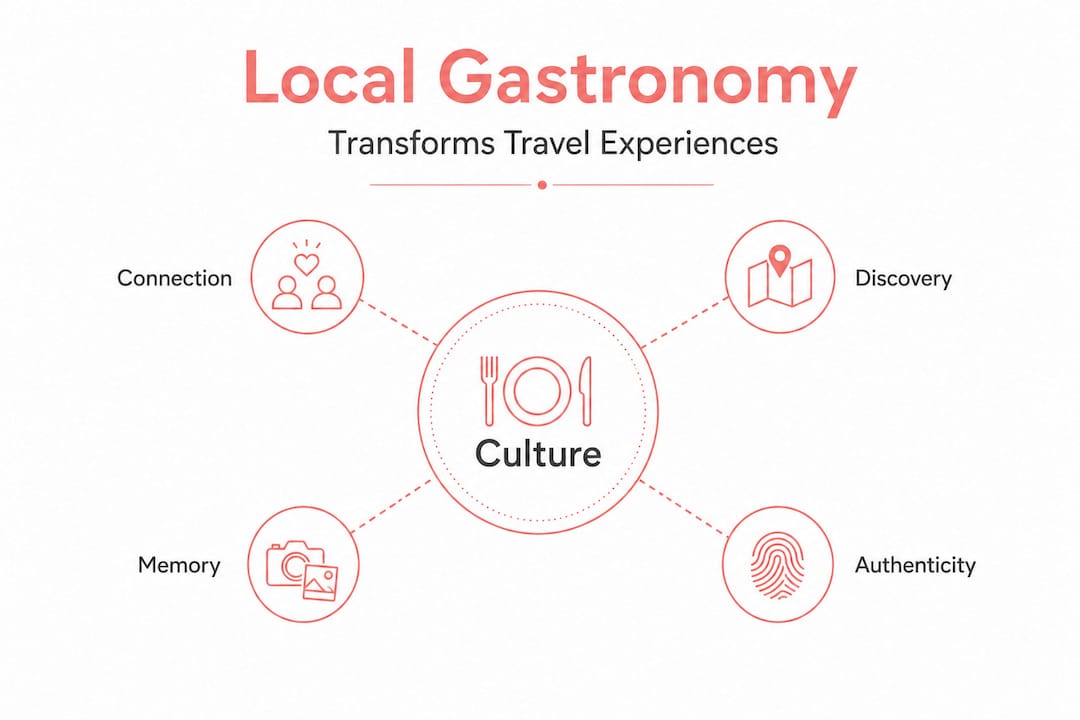
Research reinforces this further. Local gastronomy functions as a cultural translation layer, where tasting local specialties alongside interacting with people such as market vendors, regular diners, and hosts increases your perceived sense of place. This is what sociologists call host and guest interaction theory, and it explains why the same dish tastes different when a local tells you its story.
Understanding food tours and culture helps explain exactly why guided culinary experiences consistently outperform solo wandering for first-time visitors to cities like Mexico City or Seville. Here are the key ways local food translates a destination’s character:
- Language without words: Regional ingredients signal geography and climate, from saffron in Seville to pickled herring in Berlin.
- Community rhythms: Mealtimes and their rituals, late suppers in Spain, long Sunday lunches in France, reveal how people organise their days and relationships.
- Economic stories: Street food pricing and market produce reflect real local income patterns and seasonal availability.
- Historical memory: Dishes carry references to migration, occupation, and trade that no textbook matches.
“Eating locally is not a romantic notion. It is the fastest and most honest way to understand where you actually are.” This is the core principle behind every great culinary journey.
A thoughtful approach to trip curation and food consistently places gastronomy at the centre of meaningful travel design, and for good reason.
Beyond restaurant tables: Rituals and spaces travellers often miss
Having seen how local gastronomy reflects a destination’s soul, it is crucial to look beyond traditional restaurants. Most travellers plan their eating around booked tables and reviewed establishments. The result is an experience that is pleasant but partial. The real texture of food culture lives somewhere else entirely.
Markets are the obvious starting point. Hilton’s 2026 Trends Report highlights very strong interest in local everyday food rituals among travellers, confirming that people are actively seeking food contexts beyond formal dining. There is real appetite, quite literally, for the unscripted side of a city’s food life.
Food market tourism research finds that resident and tourist interaction, alongside a genuine sense of place, are the primary drivers of why travellers choose to visit food markets. In short, it is not just about buying ingredients. It is about watching a city feed itself.
Here is what you consistently miss when you skip the markets, bakeries, and grocers:
- The morning ritual: Watching Parisians queue at their neighbourhood boulangerie at 7am tells you everything about how the city starts its day.
- Vendor knowledge: A market stallholder in Mexico City’s Mercado de Jamaica will explain seasonal flowers and their culinary use in ways no restaurant menu ever will.
- Spontaneous tastings: Samples offered freely at a cheese counter or charcuterie stall introduce flavours you would never order from a printed menu.
- Price as cultural signal: Comparing market produce prices to restaurant plating reveals something honest about local food economics.
Pro Tip: On your first morning in any new city, skip the hotel breakfast and walk to the nearest covered market or bakery instead. Spend an hour simply observing before you buy anything. You will leave with more genuine understanding of that city than a full day of sightseeing would provide.
| Food space | Cultural insight gained | Interaction level |
|---|---|---|
| Sit-down restaurant | Plated tradition and regional technique | Low to moderate |
| Street food stall | Everyday comfort foods and pricing | Moderate |
| Covered market | Seasonal produce and local vendor culture | High |
| Local grocer or supermarket | Daily household staples and brand loyalty | Very high |
| Bakery or patisserie | Morning rituals and community rhythm | High |
For practical planning, a food market itinerary in Amsterdam offers a useful model that can be adapted for any major city. For broader guidance, our culinary travel tips and ways to experience local food are worth exploring before you leave home.
What culinary travellers are really seeking: Local over global
Expanding on what to look for, let us focus on how priorities shape your choices and why local always leads. There is a persistent myth that travellers want comfort and familiarity when they dine abroad. The data tells a different story.
Nearly half of culinary travellers say that discovering local dishes or specialties ranks as their top or second most important dining priority. This is a striking figure. It means that given the choice, most food-focused travellers will actively choose the unfamiliar over the reliable. Ambience, price, and international familiarity all rank lower.
| Dining priority | Culinary traveller ranking |
|---|---|
| Local dishes and specialties | Top priority for 49% |
| Unique dining atmosphere | Secondary priority |
| Value for money | Mid-range concern |
| International or familiar cuisine | Lower priority |
| Michelin-star or prestige dining | Niche priority |
This matters enormously when you are planning culinary tours because it means authenticity, not prestige, is the real driver. Here is a simple decision framework for prioritising your dining choices on any trip:
- Ask what locals eat at home. This is not always what they eat in tourist districts.
- Look for dishes with no obvious global equivalent. If you can find it at home, it is probably not the destination’s real offer.
- Prioritise neighbourhood over location. A restaurant in a residential district serving office workers at lunch is almost always more honest than one beside a cathedral.
- Choose seasonal menus over fixed ones. A kitchen that changes its menu with the market is connected to its food supply chain in a meaningful way.
- Notice who else is eating there. A room full of locals is not a guarantee of quality, but it is a very strong signal.
49% of culinary travellers rank discovering local dishes as one of the most important factors when choosing where to eat abroad.
Navigating authenticity: Local hotspots versus tourist traps
With authenticity so important, it is worth decoding the real spectrum rather than treating this as a simple binary. The tourist trap versus local gem framing makes for easy conversation, but it flattens a more interesting reality.
The distinction between tourist and local restaurants is not always clear-cut. Tourist restaurants can serve as a genuine risk-reducer when travellers need menu clarity, stable hygiene standards, and fewer unknowns, particularly in countries where language barriers are significant. The real question is whether you want a standardised experience or what might be called the destination’s kitchen dialect, the way a city actually feeds itself day to day.
Pro Tip: If you are unsure whether a restaurant is genuine or purely tourist-facing, look at the printed menu. A laminated menu with photographs in six languages is a reliable indicator that the kitchen is calibrating for visitors rather than regulars.
Here is a more useful set of criteria for finding real culinary experiences without sacrificing your comfort:
- Seek context, not just credentials. A chef-led tour in Seville with Chef Crestani gives you the backstory behind each dish, which transforms eating into understanding.
- Look for seasonal and regional specificity. Menus that change with the harvest or celebrate a regional ingredient are anchored in real food culture.
- Value the unremarkable exterior. Some of the most extraordinary food in Paris is served through unmarked doors in the 11th arrondissement.
- Trust regulars over reviews. A restaurant where the same faces return weekly is sustaining itself on genuine quality.
- Mix your venues. One fine dining experience balanced with market snacks and a neighbourhood bistro gives you the fullest picture.
Customising food tours allows you to build exactly this kind of varied itinerary, and working with a culinary expert guide means you spend your time eating well rather than second-guessing your choices.
Practical steps for unforgettable local food experiences
Finally, here are expert-backed steps to ensure every trip is rich with real flavour and local connection. Planning matters more than most travellers realise. The best food experiences rarely happen entirely by accident.
Demand evidence from culinary tourism research suggests that local-specialty discovery should be the primary promise of any well-designed food tour. This means you should hold your chosen experiences to exactly that standard.
- Research before you arrive. Identify the city’s signature dishes, seasonal produce calendar, and food neighbourhoods. For Berlin, that means understanding the Turkish market culture in Kreuzberg alongside the city’s own food history. For Mexico City, it means knowing the difference between market antojitos and restaurant alta cocina.
- Book a chef-led morning market tour first. Your first full day should begin at a food market with someone who knows every vendor. This sets the gastronomic context for everything that follows.
- Build a balance between formats. One formal sit-down meal, one street food hour, one market visit, and one neighbourhood café stop gives you four completely different windows into the same food culture.
- Engage with stories, not just flavours. Ask your guide or a vendor why a particular dish is made the way it is. The answer almost always reveals something about local history or seasonal rhythm that enriches the tasting.
- Adapt to your own comfort level. Planning immersive food travel does not mean forcing yourself through experiences that genuinely distress you. Brave choices work best when you feel safe enough to take them.
- Review and revisit. On your last evening, return to a place you loved earlier in the trip. Familiarity adds a layer of meaning that first visits cannot provide.
Working with curated chef experiences removes the research burden entirely and places you in the hands of someone whose life’s work is exactly this kind of discovery. You can also find tailored food tours for a wider range of destinations when planning ahead.
Why the best food experiences require letting go of culinary comfort zones
Here is the perspective that most food travel guides never quite say directly: careful planning will take you far, but it will not take you all the way.
The most transformative food moments we hear about from travellers consistently involve some form of surrender to the unknown. A wrong turn in Mexico City’s Colonia Roma that led to a taco stall serving something with no English equivalent on the board. A Seville bar where Chef Crestani paused the tour to let the group simply sit with locals and listen to the rhythm of conversation between a barman and his regulars. A Berlin market vendor who pressed a piece of cured fish into a traveller’s hand, insisting it needed no explanation.
None of these moments were scripted. All of them were remembered for years.
The contemporary culinary tourism trends for 2026 show a clear shift towards experiences that feel genuinely personal and locally grounded. But even the best designed tour has gaps, and those gaps are where real discovery lives.
Theoretical authenticity matters far less than practical curiosity. You do not need to be a food expert to have a profound experience at a local table. You need to be present, interested, and willing to try the thing you do not recognise on the menu. That willingness is what separates a memorable trip from a pleasant one.
Ready for your own authentic culinary adventure?
The insight in this guide points toward one clear conclusion: the most rewarding food experiences are built on local knowledge, genuine connection, and expert guidance. That is precisely what we offer at The Chef’s Tours.
Whether you are drawn to Paris with Chef PJ’s intimate knowledge of neighbourhood bistros and specialist fromageries, Seville with Chef Crestani’s mastery of tapas culture and hidden bodegas, or Berlin and Mexico City with Chef Karl Wilder’s extraordinary range across two utterly distinct food cultures, each experience is designed to give you real access to a city’s culinary identity. Explore the full range of culinary experiences to try and discover why our chef-led approach consistently delivers what travellers describe as the highlight of their trip. Food tours in Paris and beyond are waiting for you.
Frequently asked questions
What is local gastronomy and why does it matter for travellers?
Local gastronomy refers to the foods, cooking methods, and eating rituals unique to a specific place. Culinary experiences help travellers connect with a destination’s daily life and culture far beyond surface-level sightseeing.
How do food markets and grocers enhance culinary travel?
Visiting food markets and grocers lets you witness everyday food rituals and interact with residents in genuinely unscripted settings. Resident and tourist interaction and sense of place are key drivers of meaningful market visits, according to food tourism research.
Why do food-focused travellers prefer local dishes over familiar options?
Most culinary travellers actively seek the unfamiliar rather than the comfortable when dining abroad. 49% of culinary travellers rank finding local dishes or specialties as one of their most important dining priorities.
Are tourist restaurants always a bad choice for food explorers?
Not at all. Tourist restaurants can reduce risk by offering menu clarity and reliable hygiene, which is genuinely useful in unfamiliar settings. The real question is whether you want a standardised meal or a local one.
What is one practical tip for getting the most from local gastronomy?
Balance your itinerary across formal meals, street food, and market visits to capture the widest range of authentic flavours. This approach gives you multiple distinct windows into a single city’s food culture rather than a single, polished view.