

The short version
- Work the five S’s in order: see, swirl, sniff, sip, savor. Structure makes tasting easier, not stuffier.
- Judge balance, complexity and length. A finish that runs past 30 seconds tells you more than the label does.
- Check for faults before you judge quality. Cork taint and oxidation are the two worth learning.
- I don’t think price predicts pleasure. Your palate is yours, and the room you drink in changes the wine.
TL;DR:
- Master the five S’s: See, Swirl, Sniff, Sip, and Savor for a structured wine tasting approach.
- Focus on sensory details and context, including appearance, nose, palate, and environment.
- Personal curiosity and exploration often lead to more memorable wine experiences than technical perfection.
There is a real difference between drinking wine and tasting it. Most travellers swirl, sip, and nod politely without truly understanding what separates a forgettable glass from an exceptional one. The good news is that appreciating wine well is a learnable skill, not a talent reserved for sommeliers. Whether you are planning a culinary trip through Paris, Seville, Berlin, or Mexico City, knowing how to engage with wine on a deeper level transforms every tasting into something genuinely memorable. This guide draws on professional frameworks and chef-led insights to give you the practical tools that matter most.
In this article
- Master the five S’s: The foundation of tasting
- Sensory secrets: Appearance, nose, and palate decoded
- How professionals approach tasting: Frameworks and benchmarks
- Context matters: Ambience, pairings, and local chef insights
- The unconventional truth: Why personal experience trumps perfection
- Explore wine and food adventures with local experts
- Frequently asked questions
Master the five S’s: The foundation of tasting
Every professional wine taster, from casual enthusiasts to seasoned Master Sommeliers, relies on a repeatable structure. Without one, your impressions stay vague and your ability to compare wines meaningfully becomes almost impossible. The five S’s provide exactly that structure, turning a random sip into an informed evaluation.
I use this order every time, and I’ve never found a faster way to teach it.
The standard methodology for wine tasting follows the five S’s: See (appearance), Swirl, Sniff (nose), Sip (palate), and Savor (finish and balance). Each step has a distinct purpose, and skipping even one reduces your ability to assess a wine holistically.
Here is how to work through them:
- See: Hold the glass against a white background and observe colour, clarity, and depth. A pale lemon suggests youth in a white wine; deep amber hints at age or oxidative ageing. Colour alone can tell you a great deal before you smell a thing.
- Swirl: Rotate the glass to oxygenate the wine, which releases volatile aromatic compounds. This step literally wakes the wine up and coaxes out aromas that would otherwise remain hidden.
- Sniff: Bring the glass to your nose immediately after swirling and take a slow, deliberate inhale. Try to identify specific smells rather than just registering “nice” or “fruity.” Focus on fruits, florals, spices, or earthiness.
- Sip: Take a small mouthful and let it coat your entire palate. Draw in a little air through slightly parted lips. This technique, sometimes called “agitating” the wine, amplifies every structural element including acidity, tannin, and body.
- Savor: After swallowing, pay close attention to how long the flavours persist. This is the finish, and it is one of the most reliable indicators of overall quality.
“A wine with a long, evolving finish tells you far more about its quality than its label ever could.” A principle echoed by wine educators worldwide.
Consistency is what makes this framework powerful. When you apply the same five steps to every glass, you build a personal reference library of impressions that you can use to benchmark future wines. Join our chef-led wine tasting tours and you will practise exactly this process alongside professionals who have done it thousands of times.
Pro Tip: Whenever possible, taste wine alongside a small bite of local food. A slice of jamón in Seville or a fragment of aged comté in Paris immediately contextualises the wine’s structure and reveals how well it integrates with regional cuisine.
Sensory secrets: Appearance, nose, and palate decoded
Once you understand the five S’s as a framework, the real work begins: reading each sensory layer with precision. This is where many amateur tasters plateau, because they stop at vague descriptions rather than pushing for specificity.
Appearance tells a quiet but revealing story. Beyond colour, look at the wine’s clarity. Brilliant clarity usually signals careful winemaking; slight haze might indicate an unfiltered, more natural style. The “legs” or “tears” that run down the inside of the glass are often misunderstood. Contrary to popular belief, legs do not signal quality. They indicate alcohol and glycerol content, nothing more.
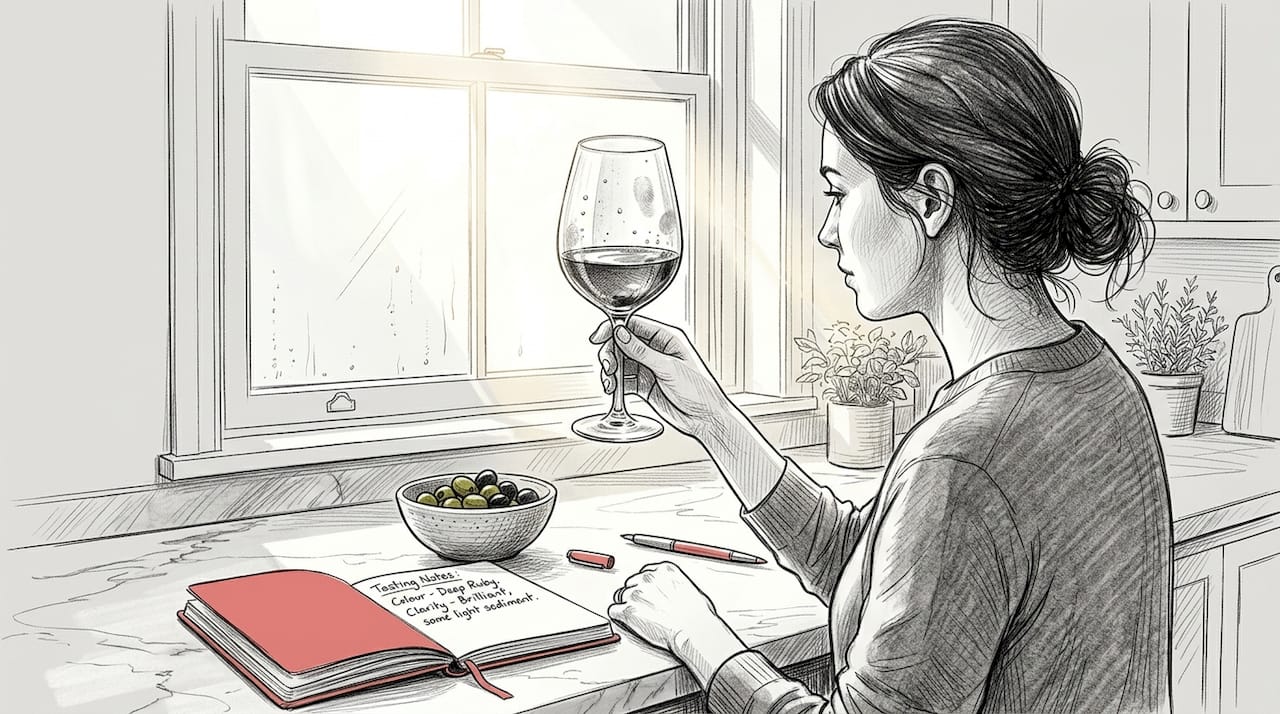
The nose is where primary, secondary, and tertiary aromas each occupy distinct sensory territory. Primary aromas derive directly from the grape: think fresh blackcurrant in Cabernet Sauvignon or white peach in a young Viognier. Secondary aromas come from fermentation, producing notes like brioche, cream, or a subtle yoghurt quality in wines that have undergone malolactic conversion. Tertiary aromas, often called “bouquet,” emerge during ageing: leather, tobacco, dried mushroom, or petrol in a mature Riesling. Learning to separate these three layers is one of the most satisfying leaps a taster can make.
On the palate, you are evaluating several structural elements simultaneously:
- Sweetness: Even dry wines carry a trace of residual sugar; recognising this helps you understand balance.
- Acidity: Makes your mouth water. High acidity, as in a Chablis, makes wine feel refreshing and food-friendly.
- Tannin: That dry, grippy sensation on your gums comes from tannin, found in red wines and some skin-contact whites.
- Body: Think of body as the wine’s weight in your mouth, from light (Pinot Grigio) to full (Shiraz).
- Finish: An exceptional finish lasts longer than 30 to 45 seconds and continues evolving with secondary flavours.
| Element | What to look for | Quality signal |
|---|---|---|
| Acidity | Salivation, freshness | Integration, not harshness |
| Tannin | Grip, dryness on gums | Ripe, not astringent |
| Body | Weight, texture | Appropriate to style |
| Finish | Length, complexity | Over 30 seconds = excellent |
| Aroma complexity | Layered, evolving | Multiple distinct notes |
Pro Tip: Try a blind tasting by covering the labels and comparing two wines side by side. Without visual bias, your senses sharpen remarkably fast. Even debunking your own assumptions about food pairing misconceptions becomes far easier when you rely purely on what you smell and taste.
How professionals approach tasting: Frameworks and benchmarks
Knowing how to taste is one thing. Knowing how to evaluate what you are tasting against a consistent quality scale is another level entirely. Two dominant professional systems are worth understanding, even if you never sit a formal exam.
Professional frameworks include the WSET Systematic Approach to Tasting and the Court of Master Sommeliers Deductive Tasting Method, both structured around appearance, nose, palate, and conclusions. The key difference is in their purpose. WSET focuses on documenting quality objectively, asking: is this wine well made? CMS pushes further into detective work, asking: what is this wine, and where does it come from? Both are extraordinarily useful for culinary travellers.
The WSET quality scale runs from faulty through poor, acceptable, good, very good, and outstanding. Each level is defined by balance, complexity, and length rather than subjective enjoyment. A wine can be outstanding technically while not being to your personal taste, and understanding that distinction is genuinely liberating. It means you can appreciate a wine’s craftsmanship without pretending to love it.
Here is how to apply a simple professional checklist during any tasting:
- Identify balance: No single element (acid, tannin, alcohol, sweetness) should dominate. They should feel integrated.
- Note complexity: Count distinct aromas or flavours. A complex wine reveals new layers as it opens in the glass.
- Assess length: Time how long the aftertaste persists. Longer is consistently better.
- Look for typicity: Does the wine reflect the character of its grape variety and region? This requires practice but builds intuition over time.
Now, faults. Knowing how to spot a flawed bottle is one of the most practically useful skills a culinary traveller can develop. Cork taint (TCA) affects roughly 7% of cork-sealed bottles and produces a musty, wet cardboard smell that strips all fruit from the wine. Oxidation creates nutty, flat aromas and a brownish tint in red wines. Volatile acidity, caused by excessive acetic acid, shows up as a sharp vinegar or nail polish note on the nose.
“Always smell the wine before you taste it. The nose catches faults that the palate might rationalise away.”
Interestingly, some faults exist on a spectrum. Volatile acidity in a well-aged Barolo, for instance, is often considered a complex quirk rather than a defect, adding intrigue rather than ruining the wine. Context and degree matter enormously. Explore tasting tour frameworks to see how guided experiences help you practise fault detection in a supportive, educational environment.
Context matters: Ambience, pairings, and local chef insights
Here is something that the textbooks rarely emphasise enough: the wine in your glass does not exist in a vacuum. The room you are sitting in, the people you are with, the food on your plate, and even your mood that afternoon all shape what you perceive in the glass.
Bottle variation is real, caused by cork or air ingress, and mood, ambience, and context affect perception as much as the wine itself. Research consistently shows that the same wine poured in a beautiful setting is rated higher than when poured under harsh fluorescent lighting. This is not a trick of the mind. It is how sensory experience works holistically.
Food pairing is another area where received wisdom often misleads. The “white with fish, red with meat” rule oversimplifies dramatically. What actually determines a successful pairing is the structural relationship between food and wine: acidity, body, fat content, and weight. A rich, full-bodied white Burgundy pairs beautifully with roast chicken, while a light Pinot Noir sits elegantly alongside grilled salmon. Price, as many culinary travellers discover in Seville or Mexico City, has almost nothing to do with pairing success.
Here is what makes city tastings genuinely special:
- Local chefs understand regional wine culture in ways that general guides cannot replicate. Chef Crestani in Seville knows precisely which local Palomino Fino complements a plate of Ibérico ham in a way that no textbook can prescribe.
- Small-group settings allow for more personal, responsive tasting experiences where questions actually get answered.
- Hidden venues off the tourist trail tend to offer more authentic pours and producers who are passionate rather than commercial.
- Seasonal variation in local produce influences which wines are at their peak, and local chefs navigate this instinctively.
Pro Tip: Plan your tasting session for mid-morning or early afternoon when your palate is freshest. Avoid heavy meals or strong coffee immediately before a tasting, as both dull your ability to detect subtle aromatics. Follow the local chef tasting advice from those who know their city’s wine culture inside out, or map out your experience with a structured approach to planning a gourmet wine tasting journey before you arrive.
The unconventional truth: Why personal experience trumps perfection
We have spent this guide building a framework: five S’s, sensory layers, professional benchmarks, fault detection, contextual awareness. All of it is genuinely useful. But here is what we have learned from years of running culinary experiences across Paris, Seville, Berlin, and Mexico City: the most memorable wine moments almost never happen when someone is being technically perfect.
I prefer a cheap bottle drunk in the right room to an expensive one drunk badly.
Practising blind tasting grids and fault detection, building a reference library through side-by-side comparisons, is the empirical path to reliable discernment. We advocate it. But the single best thing a culinary traveller can do is remain genuinely curious and resist the temptation to perform expertise rather than experience it.
The traveller who orders a local natural wine in a small Berlin bar, knowing nothing about it, and sits with the glass long enough to find something unexpected in it, often learns more than someone mechanically ticking boxes on a WSET grid. Structure gives you the ability to taste deeply. Curiosity gives you the desire to. You need both, and you need to keep them in proportion.
Insider access to chef-led tastings exists precisely for this reason. The chefs who lead our experiences do not lecture. They facilitate discovery. They pour wines that surprise you, explain them in plain language, and let the conversation take the tasting somewhere genuinely interesting. That is the real secret that no five-step framework fully captures.
Explore wine and food adventures with local experts
Now that you have a solid foundation in both technique and mindset, the most natural next step is putting it into practice somewhere extraordinary.
At The Chef’s Tours, our chef-led culinary experiences are designed to bring every tip in this guide to life in real kitchens, markets, and tasting rooms. Chef PJ takes small groups through the hidden wine bars and fromageries of Paris. Chef Crestani reveals the sherry producers and tapas bars that Seville’s culinary insiders actually visit. Chef Karl Wilder uncovers the craft natural wine scene in Berlin and the vibrant mezcal and wine culture of Mexico City. Each experience is intimate, personalised, and guided by someone who genuinely loves where they live. Explore our food and wine tours in major cities and book the tasting adventure that suits your next journey.
Frequently asked questions
What are the five S’s in wine tasting?
The five S’s refer to See, Swirl, Sniff, Sip, and Savor, a systematic approach used by professionals and enthusiasts to evaluate any wine methodically and consistently.
How do experts judge the quality of a wine?
Experts assess a wine’s balance, complexity, and length, using structured methods like WSET or CMS. The WSET quality scale runs from faulty through to outstanding, based on objective structural criteria rather than personal preference alone.
Can the atmosphere really affect how wine tastes?
Yes, significantly. Mood, ambience, and context influence your perception of wine as much as the wine itself, which is why setting genuinely matters during any tasting experience.
How do I spot if a wine is faulty?
Start with the nose before tasting. Common faults include cork taint, which smells of wet cardboard in roughly 7% of bottles, oxidation with nutty or browning notes, and volatile acidity, which registers as vinegar or nail polish.
Do I need expensive wine to enjoy a great tasting?
Not at all. Price does not equal pairing success, and many outstanding wines come from small, affordable producers. Focusing on structure, balance, and your own honest preferences will serve you far better than chasing prestigious labels.