

TL;DR:
- Authentic dining is rooted in local culture, seasonality, and genuine community rather than tourist-oriented setups.
- Finding authentic experiences requires research, local language tools, and trusting insider recommendations over mainstream review platforms.
You land in Paris, Seville, or Mexico City buzzing with anticipation, only to find yourself queuing outside a restaurant with laminated menus, stock photos of every dish, and a staff member waving an English translation at you before you’ve even sat down. It’s a familiar trap, and it robs you of the very thing you travelled for. Authenticity in dining strongly correlates with satisfaction across emotional, cultural, and enjoyment dimensions, yet most travellers never quite crack the code for finding it. This guide changes that.
Table of Contents
- What defines authentic dining?
- How to prepare: Research tactics and essential tools
- Step-by-step: Finding and booking authentic dining with local chefs
- Verification: Confirming authenticity during your experience
- Why chasing authenticity is about more than food
- Discover your next authentic dining adventure
- Frequently asked questions
Key Takeaways
| Point | Details |
|---|---|
| Check local cues | Menus in the local language and a crowd of regulars hint at true authenticity. |
| Use verified sources | Platforms like TasteAtlas and established guides connect you to real chef insights. |
| Engage local chefs | Booking chef-led tours gives insider access and richer cultural context. |
| Balance street and fine dining | Street food can be just as, if not more, authentic and rewarding as high-end restaurants. |
What defines authentic dining?
To understand how to find authentic meals, it helps to know what makes a meal “authentic” in the first place. Authenticity is not simply about old buildings or rustic crockery. It runs deeper than atmosphere.
Physical and menu-based indicators tell you a great deal before a single bite. Key authenticity signals include local queues with few or no tourists, elderly cooks visible in open kitchens, small or handwritten menus, no English translations in non-English areas, and minimal dishes built around that morning’s market produce. A restaurant chasing tourist volume needs to please everyone. A place feeding its own neighbourhood only needs to please locals.
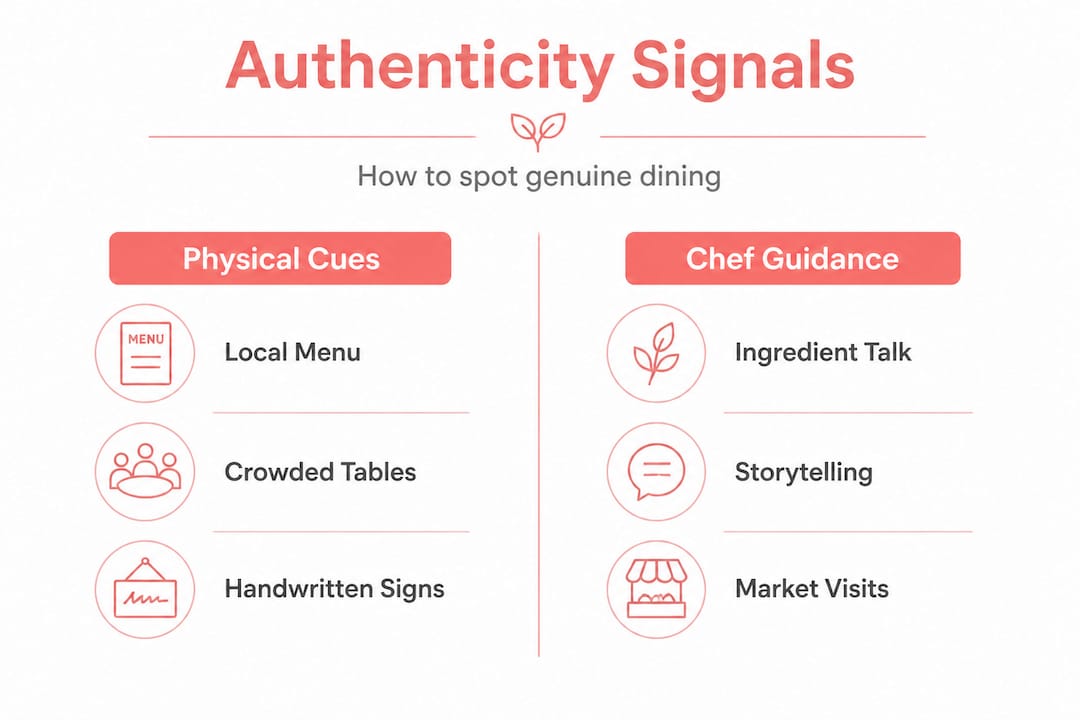
Chef guidance adds another layer entirely. When a local chef walks you through a market or a neighbourhood, they are not reading from a script. They are sharing personal relationships with vendors, producers, and family-run institutions that no algorithm can surface. This is why experiencing local cuisine with a knowledgeable guide transforms a meal into a memory.
| Feature | Authentic spot | Tourist-facing restaurant |
|---|---|---|
| Menu length | Short, focused, seasonal | Long, with photos and translations |
| Clientele | Mostly local residents | Predominantly tourists |
| Pricing | Moderate, reflects local economy | Inflated, often lacks value |
| Kitchen visibility | Open or semi-visible, traditional | Often closed or theatrical |
| Language | Local language dominant | English-first or multilingual |
The emotional stakes are real. An empirical study in Manila confirmed that genuine cultural presentation and immersive dining contexts significantly boost overall satisfaction. Put simply: when you feel a meal is real, you enjoy it more. As food writer and traveller Fuchsia Dunlop once noted:
“The best meals I’ve eaten have not been in celebrated restaurants but in unmarked kitchens where someone was cooking exactly what they wanted to eat.”
Authentic travel rewards go well beyond taste. They build empathy, cultural understanding, and stories you will still be telling years later. That is the true measure of a great meal abroad.
How to prepare: Research tactics and essential tools
Once you know what authentic looks like, the next step is arming yourself with the right tools and tactics to find these experiences.
The internet is full of well-meaning but misleading advice. Mass-market platforms like TripAdvisor and Yelp are systematically skewed towards tourist-heavy, English-speaking establishments that spend money on visibility. Smarter search tactics include switching Google Maps to the local language, which surfaces high-rated spots with few or no English-language reviews. TasteAtlas is invaluable for identifying regional dishes by geography, helping you understand what you should be eating before you arrive. Eatwith connects you with home cooks hosting small intimate dinners, which is as close to a local kitchen as a visitor can realistically get.
Verified editorial sources are equally important. Food & Wine, Michelin, and Eater all offer vetted insights from local chefs across major cities, giving you a curated starting point that cuts through noise. These are not infallible, but they represent genuine culinary curation rather than crowd-sourced popularity contests.
Here is a practical preparation sequence before you travel:
- Identify your destination’s signature dishes using TasteAtlas. Know what cocido madrileño tastes like before you sit down for it in Seville, or what a proper crème brûlée should be before you order one in Paris.
- Switch Google Maps to the local language and search for the dish or cuisine type. Look for places with hundreds of reviews but minimal English commentary.
- Cross-reference with one editorial source such as Food & Wine or a city-specific blog written by a resident, not a travel writer passing through.
- Check social media in the local language. Instagram hashtags in Spanish, German, or French will show you where residents are actually eating and celebrating.
- Book a vetted tour or experience through a platform that connects you with resident chefs. Finding local food tours run by genuine locals eliminates research guesswork entirely.
| Platform | Best used for | Pitfalls |
|---|---|---|
| Google Maps (local language) | Finding neighbourhood gems | Requires language switching |
| TasteAtlas | Discovering regional dishes | Limited booking functionality |
| Eatwith | Home-cook intimate dinners | Availability varies by city |
| TripAdvisor / Yelp | General tourist logistics | Heavy tourist bias |
| Food & Wine / Michelin | Vetted chef-recommended spots | Can skew upmarket |
Local excursions led by knowledgeable insiders remain the most efficient shortcut. You avoid the planning paralysis and land straight in the right room with the right people.
Pro Tip: Before any trip, spend twenty minutes reading restaurant reviews written in the destination’s language using Google Translate. The vocabulary locals use, such as “de siempre” in Spanish (meaning “as it’s always been”) or “traditionnel” in French, signals the kind of place residents value most.
Curated food experiences designed by resident experts solve the preparation problem almost entirely. You arrive informed, guided, and ready to eat.
Step-by-step: Finding and booking authentic dining with local chefs
Equipped with research, you can now follow a clear path to book and enjoy unforgettable, chef-led dining encounters.
The process is straightforward when you know the steps. Skipping any of them is where travellers typically go wrong.
- Define what you want from the experience. Are you after a single extraordinary meal, a market walkthrough, a tasting progression across a neighbourhood, or all three? Clarity helps you choose the right platform or tour operator.
- Research specific dishes and producers in your destination. In Berlin, that might mean understanding the difference between currywurst street culture and the natural wine bar scene. In Mexico City, it might mean knowing which neighbourhoods still cook pre-Hispanic dishes.
- Shortlist three to five places using the research tools above. Do not book yet. Cross-reference each against the authenticity indicators from the first section.
- Contact the restaurant or tour directly if possible. A quick message asking about seasonal specials or market sourcing tells you a great deal about a place’s attitude. Establishments that respond with enthusiasm and specificity are usually the real thing.
- Book through a reputable platform or directly with a chef. The Food & Wine restaurant guide lists over 335 chef-recommended restaurants across ten cities, curated by 66 Best New Chefs, filterable by style and neighbourhood. It is an exceptional starting resource for cities like New York, Los Angeles, and Chicago.
- Confirm logistics 48 hours before. Authentic spots, particularly small family-run ones, sometimes change opening hours seasonally or close unexpectedly. A quick confirmation call or message prevents disappointment.
- Arrive without rigid expectations. The best authentic dining experiences often diverge from what you planned. That improvisation is part of the value.
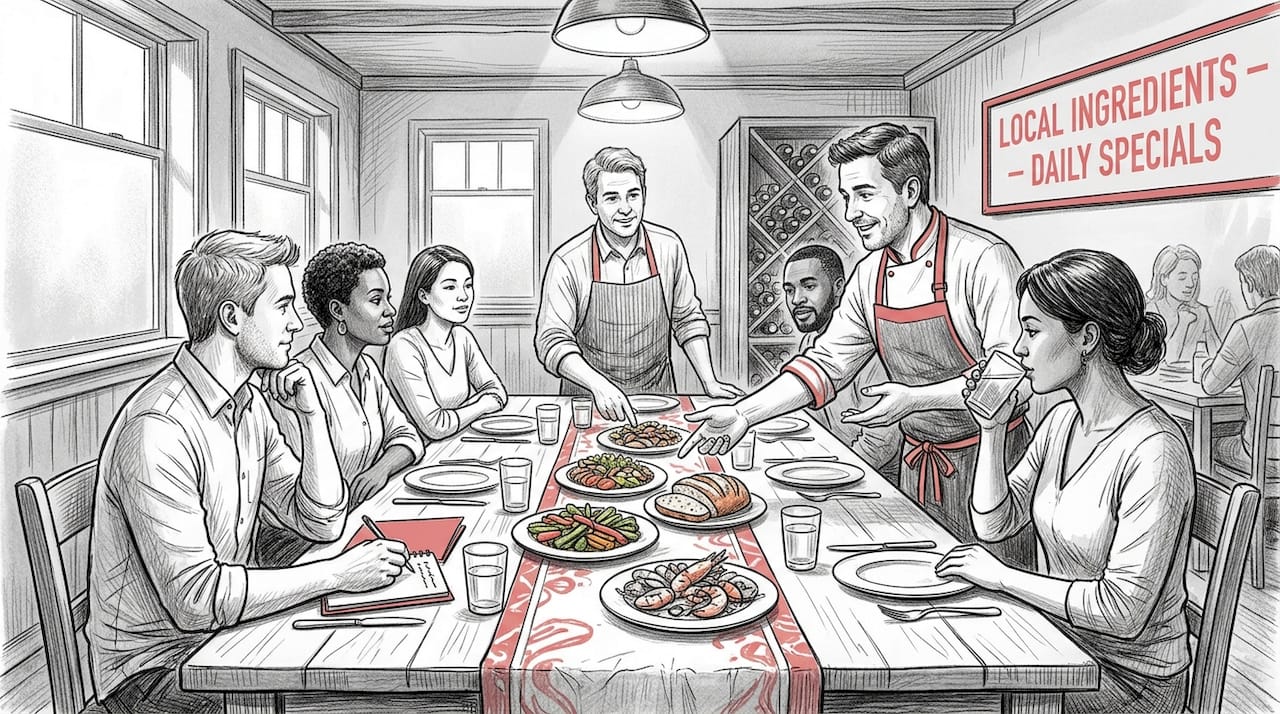
When engaging a chef-led tour, look for operators who keep group sizes small, typically six to eight people, and who take you into neighbourhoods rather than along tourist corridors. Authentic food culture with chefs is built on personal relationships and insider access, not on choreographed itineraries.
Pro Tip: Learn how to spot tourist food tours before you book. Red flags include large group sizes, stops at restaurants with TripAdvisor “Travellers’ Choice” badges prominently displayed, and tour descriptions that emphasise “famous” rather than “local.”
Verification: Confirming authenticity during your experience
Enjoying the meal is only part of the journey; verifying authenticity ensures lasting memory and meaning.
Once you are seated or standing at a stall, use your surroundings to confirm you have made the right call. These on-the-ground cues are far more reliable than any online review.
Signs you are in the right place:
- The menu changes seasonally, or even daily, based on market availability
- You can see or hear cooking happening in an actual kitchen, not a reheating station
- The clientele is predominantly local, including families, elderly residents, and workers on lunch breaks
- The staff are genuinely surprised or delighted that a foreign visitor has found them
- Prices reflect local economic reality rather than tourist premiums
- The chef or owner comes to your table without prompting, curious about your reaction
Hyper-local sourcing and seasonality are among the most reliable benchmarks of authenticity. If you can, visit the nearest market early in the morning and watch which restaurants are buying directly from producers. Those are the places worth visiting that evening.
Street food deserves particular attention here. Many travellers assume authenticity requires a tablecloth and a reservation. It rarely does. Research consistently shows that authenticity drives satisfaction whether you are spending five euros at a taco stall or fifty at a bistro. Street food eaten standing up, surrounded by locals on their lunch break, often delivers more cultural weight than a tasting menu in a formal setting.
“The street is the truest kitchen. It has no budget for pretence.”
Locals shaping authentic travel is not a romantic idea. It is a practical reality. When a resident chef points you towards a specific stall or a particular bacalhau dish in a particular back-street kitchen, they are drawing on decades of lived experience that no guidebook can replicate.
The benefits of curated experiences become most visible precisely in these moments of verification. You are not just eating well. You are eating correctly, in context, with understanding.
Why chasing authenticity is about more than food
Here is something we have learnt from years of running chef-led tours across Paris, Seville, Berlin, and Mexico City: the travellers who get the most from authentic dining are rarely the ones obsessing over credentials.
The checklist approach to authenticity has real limits. You can tick every box and still leave feeling hollow if you are not genuinely curious about the people behind the food. Conversely, a simple plate of grilled fish at a harbour-side stall can be the meal of a lifetime if the vendor tells you the story of the catch while you eat.
Mexico City illustrates this tension perfectly. Both Pujol and Quintonil hold two Michelin stars and stand as landmarks of the city’s food culture, yet regular visitors describe Pujol as more “essential” and historically significant, while Quintonil feels more “alive” and forward-looking. Neither is more authentic than the other. They express different truths about the same city. The meaningful question is not which one is more real, but which one speaks to you in this particular moment of your journey.
This is the nuance that the role of culinary experts becomes genuinely irreplaceable. Chef Karl Wilder in Mexico City is not simply a navigator. He is an interpreter. When he takes you to a neighbourhood mercado before walking you to a table where a family has cooked the same mole recipe for four generations, the credential of the kitchen matters far less than the living continuity of the dish.
The emotional and cultural connections triggered by genuine food experiences are what most travellers remember long after they’ve forgotten the name of the restaurant. A story told by Chef PJ in a Paris fromagerie, or Chef Crestani explaining the Arab influence on Seville’s pastry tradition, rewires how you understand a place in ways that no hotel concierge recommendation ever could.
Authentic dining is, in the end, about encounter. Food is the vehicle. The destination is understanding.
Discover your next authentic dining adventure
Having explored the steps, take your passion for authentic food to the next level with curated support.
We connect culinary travellers with resident chefs who know their cities the way only lifelong insiders can. Whether you are drawn to a morning market in Seville with Chef Crestani, a hidden bistro crawl in Paris with Chef PJ, or an underground dining scene in Berlin or Mexico City with Chef Karl Wilder, every experience is designed around real access and genuine flavour.
Our culinary experiences to try span small-group tours, private tastings, and corporate events, all built on the same principle: local knowledge is irreplaceable. If you want to understand why chef-led food tours consistently outperform standard guided options, the answer is simple. When a chef takes you somewhere, it is never a compromise. Browse our culinary city tours and book the experience your next trip deserves.
Frequently asked questions
How do I spot a tourist-focused restaurant quickly?
Look for handwritten or minimal menus and a clientele made up mostly of local residents. Steer clear of any place displaying English-first menus in a non-English-speaking area or tables packed exclusively with tourists.
Is booking a chef-led food tour more authentic than going solo?
Chef-led tours offer insider access and local narrative that independent research rarely matches, though using vetted editorial sources and local-language searches can also yield genuinely authentic finds if you invest the time.
Do street food stalls count as authentic dining?
Absolutely. If a stall sources local ingredients and is popular with residents rather than tourists, street food often delivers higher authenticity and better value than many formal dining rooms.
What platforms help find the most authentic experiences?
Search Google Maps in the local language and explore TasteAtlas for regional dish discovery or Eatwith for home-cook dinners. Tourist-skewed platforms like TripAdvisor and Yelp are best avoided for authenticity-focused searching.
What if a restaurant is Michelin-starred — does that guarantee authenticity?
Not necessarily. As the Pujol versus Quintonil debate in Mexico City demonstrates, even two comparable Michelin-starred restaurants express authenticity differently. Family kitchens and street stalls can offer a truer local experience than any starred establishment.
Recommended
- How to Find Local Food Tours for Authentic Culinary Experiences
- 5 authentic ways to explore food culture with local chefs
- Top ways to experience local cuisine as a culinary explorer
- How local chefs shape authentic culinary tourism
- Oplev de bedste lokale madoplevelser i Danmark – Rejs i Danmark
- What ‘authentic’ Mexican food really means for Canadians – Burrito Splendido